

Undesign Thinking
Part 1: the contexts

As a citizen, when you have accessed a new or a redesigned government online service, you have likely engaged with the outcomes of design thinking — a product or a service that supposedly has been designed with your needs in mind and with a dose of empathy regarding your personal situation that has brought you to the service. If, during the last couple of decades, you’ve spent any time around projects that include products and services and thinking about their end-users (like I have), it has been hard to miss ‘design thinking’.
The number of more specific design disciplines that have embraced design thinking include product design, interaction design, user experience design, and service design. A useful starting point for seeing what these kinds of activities have in common is defining design as ‘rendering of intent’. Designer Jared Stoll explains it as follows:
we’ve started explaining design as “the rendering of intent.” The designer imagines an outcome and puts forth activities to make that outcome real. We’ve found this definition seems to resonate with people more than any other. People can see the relationship between the intended outcome and the process that renders it.
If design is about making intentions concrete, design thinking was meant to produce human-centred outputs instead of technology or organisation centred ones. However, what if similar aspirations would be practiced from regenerative ends, hospicing the unsustainable luxuries and frivolities of modernity and designing away from ‘progress’ towards a new civilisation? That is what I want to explore in this two-part essay, first outlining where design thinking (hence ‘DT’) came from and touch on its critiques. Then, in the second part, I will sketch an alternative process which is aimed at recognising and repurposing — sometimes even dismantling, hence the ‘un’ in undesign — the structures where DT has predominantly been practiced. I argue that those structures have led those of us involved in design processes to adopt and promote framings that enable and privilege throwing technology at technologically interpretations of the problem rather than the problem itself.
What is (was) design thinking?
The roots of design thinking are in the convergence of specialised fields of knowledge after World War II. Designers Rikke Friis Dam and Teo Yu Siang describe in The Interaction Design Foundation’s blog, how ”the Industrial Revolution and World War II pushed the boundaries of what we thought was technologically possible. Engineers, architects and industrial designers—as well as cognitive scientists—then began to converge on the issues of collective problem-solving, driven by the significant societal changes that took place at that time.”
Dam and Teo write about how the problem-solving process “started to combine the human, technological and strategic needs of our times, and progressively developed over the decades to become the leading innovation methodology it is today.”
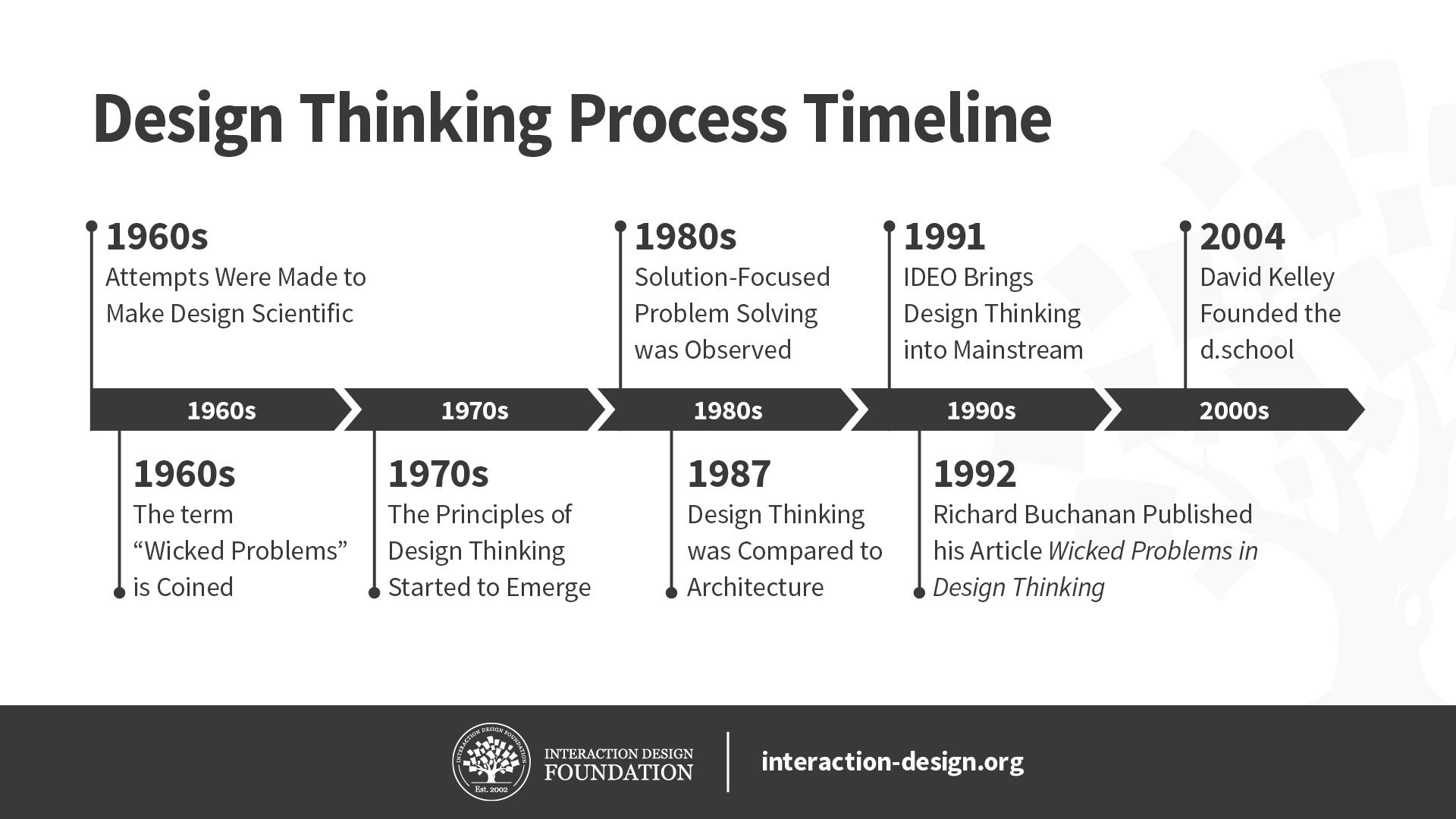
In the timeline below, from the same article, we see how various approaches to solving ‘wicked problems’ led to the current day, and how the design agency IDEO, among others, commercialised DT as a service offering.
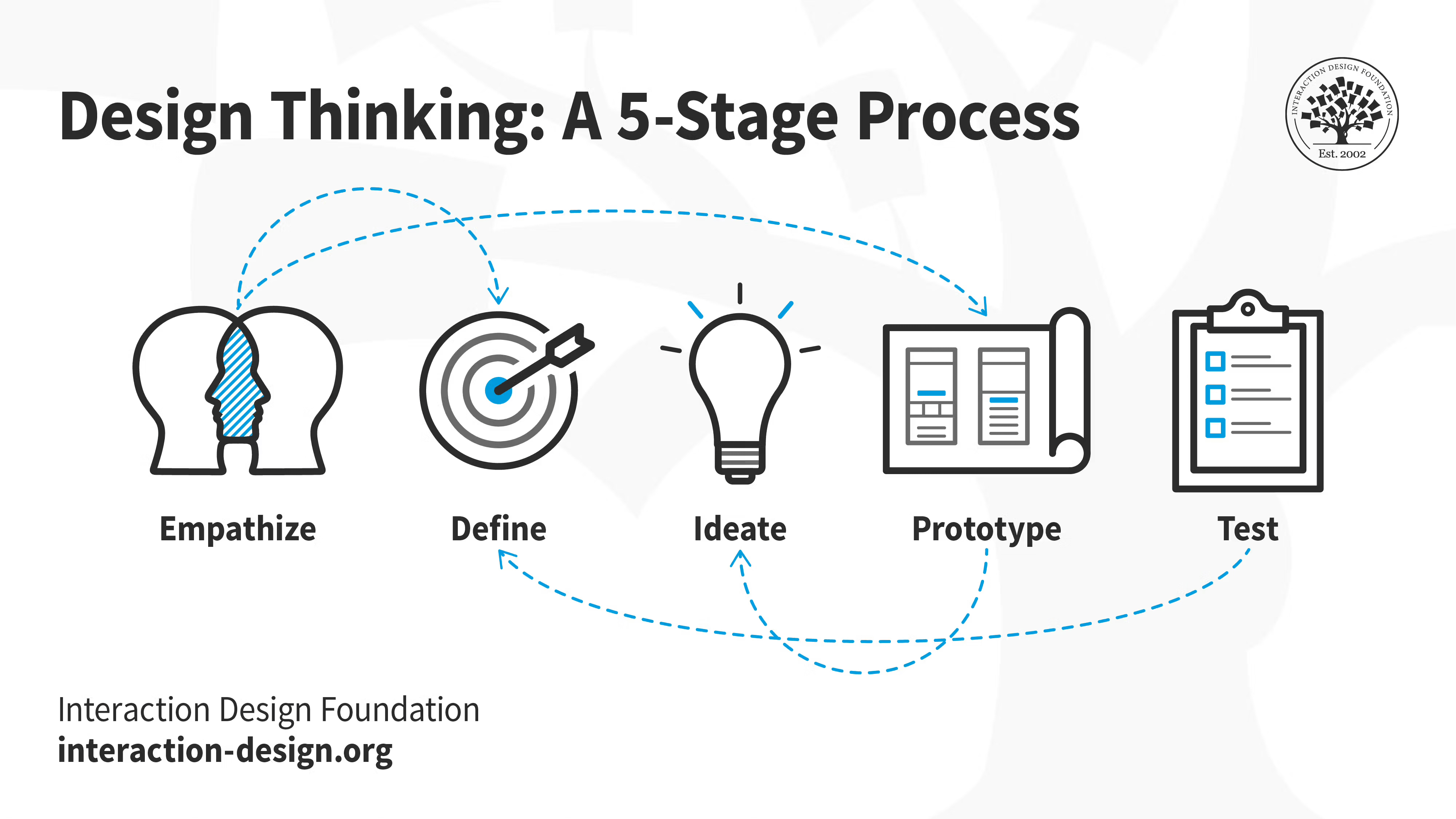
The outputs of design thinking have typically been a result of a creative problem-solving process that involves design agencies and the owners of the product or service with the targeted end-users involved in the process to varying degrees. As it is practiced today, DT is typically divided into phases that inform each other in iterative fashion, to uncover and address hidden assumptions, user needs, and initially unknown aspects of the problem. In an introductory article, Dam and Teo write: “Design thinking is an iterative and non-linear process that contains five phases: 1. Empathize, 2. Define, 3. Ideate, 4. Prototype and 5. Test. You can carry these stages out in parallel, repeat them and circle back to a previous stage at any point in the process.”
Design agency Fjord’s co-founder Mark Curtis, who is among those who witnesses the rise of DT over the last decades, has recently written about where design has come from and is going. He employs the word in the broad sense, as having to do with people and practices that build products, services, and experiences. Curtis sees the rise of design thinking as a janus-faced phenomenon: the term turned out to be accessible for executives, and therefore it helped spread a certain design sensibility in corporate settings. However, at the same time, the accessibility too often lead to outcomes where little actual design got done — the ‘thinking’ was not followed by design doing and design culture, in Curtis’ words. And doing can’t be faked, nor can culture — hence, ‘design thinking’ was practiced superficially; it only scratched the surface of the actual issues and appeased ‘stakeholders’ who had read a Harvard Business Review article about it.
Writing for the MIT Technology Review about DT’s broken promises, Rebecca Ackermann echoes Curtis’ interpretation of how the domain of ‘design’ expanded:
Design thinking also broadened the very idea of “design,” elevating the designer to a kind of spiritual medium who didn’t just construct spaces, physical products, or experiences on screen but was uniquely able to reinvent systems to better meet the desires of the people within them. It gave designers permission to take on any big, knotty problem by applying their own empathy to users’ pain points—the first step in that six-step innovation process filled with Post-its.
It is telling that the roots of DT are in post-war era when innovation activities as we know them started to accelerate, aligning with the simplistic narrative that traditional economics tells, i.e. ignoring questions about natural resources and other ’externalities’ and encouraging competition and infinite growth. Ackermann refers to pockets of contemporary design thinking practitioners trying to rethink its premises: “These new efforts seek a set of design tools capable of equitably serving diverse communities and solving diverse problems well into the future. It’s a much more daunting—and crucial—task than design thinking’s original remit.“
However, the death of design thinking is frequently reported these days. Mark Curtis doubts that DT is going away (as some provocations have argued) but sees the evolution of design thinking as moving from solidifying internal design practices within organisations — ‘design within’ — to inter-organisational collaborations to address the increasingly complex and porous boundaries between systems: ‘designing across’. In less abstract terms, that might mean design-led alliances addressing the climate emergency, for example.
Curtis also talks about the rise of ethical perspectives within design practices. But, across the two essays, his reflections stay safely within the confines of what modernity wants — growth, progress, etc — rather than stewarding our ways out of modernity and the trouble we are in.
Tellingly, Rebecca Ackermann is less confident, given DT’s past shortcomings. There is work to be done to repair its legacy:
design thinking’s greatest positive impact may always have been in the stories it’s helped tell: spreading the word about the value of collaboration in business, elevating the public profile of design as a discipline, and coaxing funding from private and public channels for expensive long-term projects. But its legacy must also account for years of letting down many of the people and places the methodology claimed it would benefit.
DT as relational practice
Long before the above, more recent reflections on DT, in a 2011 article Lucy Kimbell, a design practitioner and an academic, delivered a two-part critique of design thinking. She questioned underlying assumptions of the practice and how it has been promoted. Kimbell identified three characteristics about design thinking that were typically discussed during its emergence: first, as a cognitive style, i.e. a particular approach to problem solving, second as a general theory of design i.e. how it should be practiced and to what ends, and finally, as a resource for organisations i.e. how DT could be embedded into organisations by leveraging the other two aspects.
Kimbell also put forward three lines of critique towards the claims made about DT: 1) that it upholds a dualism between thinking and knowing and acting in the world, 2) that it ignored the historical situatedness and diversity of design practices, and 3) that it privileged the designer as the main agent of the outcomes. (It’s worth noting that the definition of design by Jared Stoll I referred to in the beginning can be criticised for upholding this centring aspect.)
As a response, Kimbell proposes rethinking DT with moving away from disembodied and ahistorical approaches and towards privileging the embodied and situated aspects of designers and participants in the design process. One of her interests is, on the back of how DT broadened the notions of what design is, to identify what is ‘special’ about design, if anything:
By focusing on situated, embodied material practices, rather than a generalized “design thinking,” we may shift the conversation away from questions of individual cognition or organizational innovation. Instead, design becomes a set of routines that emerge in context. Such explorations help clarify designers’ material practices. They also force us to decide if design is a special way of engaging with and acting on the world, unique to designers, or shared by others such as managers too.
In the second part of her critique, Kimbell introduces two concepts to describe designing: design-as-practice and designs-in-practice.
Designs-in-practice is about the emergent nature of design outcomes. The wording deliberately “draws attention to the impossibility of there being a singular design” and the incompleteness of design outcomes, as they evolve in the actual use over time and space. It’s about the breadth of variety in how the design outcomes get distributed and engaged with in embodied, historical, and therefore situated contexts.
Design-as-practice is about the relationality of design practice, how the outcomes do not meaningfully exist by themselves any more than the design activity and designers do. Again, Kimbell underlines the embodied and situated nature, but this time regarding the design process rather than the outcomes. The notion, as I understand it, attempts to capture the tacit knowledge and unconscious habits that go into producing any kinds of design outcomes:
Design-as-practice cannot conceive of designing (the verb) without the artifacts that are created and used by the bodies and minds of people doing designing. This way of thinking of design sees it as a situated and distributed unfolding in which a number of people, and their knowing, doing, and saying, and a number of things, are implicated.
Kimbell emphasises the practice nature of design thinking; she writes how the practice orientation “sees design as situated, local accomplishment” that transcends the dualisms of subject and object, nature and culture, body and mind, and sees the practice “as dynamic configurations of minds, bodies, and objects, discourses, knowledge, structures/processes, and agency”. This perspective decenters the designer as the main agent of designing while paying attention to the objects and materials that are being used and produced during the process in a web of relations. Essentially, she produces a relational reading of a design thinking practice: “In the practice approach, design is understood as relational, and it cannot be conceived of without the practices within which designing and designs are constituted.” This also means that the adage of design being ‘human-centred’ betrays the relational aspect — design activity as a creative process does not have a centre. The relations are more important than what they relate to.
I find that Kimbell’s arguments lend well to the local, living, and entangled aspects of the type of ‘undesign thinking’ that I am deliberating here. Obviously, I am not the first to address the topic. In the MIT Technology Review article, Ackermann cites Wes Taylor, an associate professor at Virginia Commonwealth University and the leader of the Design Justice Network: According to Taylor, “design thinking’s core problems can be traced back to its origins in the corporate world, which inextricably intertwined the methodology with capitalistic values. He believes that a justice lens can help foster collaboration and creativity in a much broader way that goes beyond our current power structures. “Let’s try to imagine and acknowledge that capitalism is not inevitable, not necessarily a foundational principle of nature,” he urges.”
The Design Justice Network sets out ten commendable principles, such as “We work towards non-exploitative solutions that reconnect us to the earth and to each other” and “We prioritize design’s impact on the community over the intentions of the designer”, something which Lucy Kimbell writes about in her critique of DT. However, I am interested in complementing such principles with a reinterpretation of the design thinking process, with the particular emphasis of designing away from technology — or what has become to be called ‘tech’ — associated with new, ‘cool’, digital shiny things that nevertheless eat away at our connections to other living beings and the living planet.
What is right for design in the time of the polycrisis?
“Rather than create more ‘ green’ things that simply add to ‘consumer choice’ – houses, cars, shirts, shoes, breakfast cereals, lawnmowers, carpets etc. – the imperative is the elimination, by design, of the unsustainable.” — Tony Fry, Elimination by Design (2003)
I have both practiced and taught design thinking in various settings during the past couple of decades, drawing from the work of such luminaries as Don Norman and Bill Buxton. I found Buxton’s approach to ‘sketching user experiences’ and the slogan he co-authored, ‘getting the right design and the design right’, particularly inspiring.
But the sense of what is right is changing. It used to mean, and predominantly still does, finding a design solution that optimally serves the needs of the users that it is designed to help while generating profits for both the design agencies and their (commercial) clients. In certain design domains, such as games, it also meant that the activity designed for the end-user would be satisfying in the ways that the genre of the end product implied. For example, playful mechanics have seeped their ways into various non-gaming apps (Duolingo, etc) to retain us as ‘users’.
This kind of right, however, has been mostly practiced in the service of modernity’s ideologies; ideologies that have damaged the planet and the vast majority of global citizens. Complementary and corrective approaches such as value-sensitive design or responsible innovation frameworks have not made a huge difference. They have mostly sought to design more instead of less, to increase productivity instead of contemplation, to drive consumption instead of frugality, and so on. Growth has been, and continues to be, the mantra guiding design practices and decisions.
In rare cases, design thinking has aimed at negation on a material level. Sure, by applying the thinking to design services its practitioners have aimed to negate phenomena, such as exclusion and lack of accessibility — or wasteful use of resources, even. But seldom have these ends served deliberate leaving behind of technology or questioning its role in developing a service or other. Rather, while I don’t have numbers, I’m confident to claim that design thinking has mostly sought applications for new technology out there, to appear to stay with ‘progress’. Today, there are likely numerous agencies out there practicing and selling design thinking around how to use generative AI in solving a problem. If this is the case, it reinforces the deterministic narrative about AI rather than questions it.

Towards (un)design
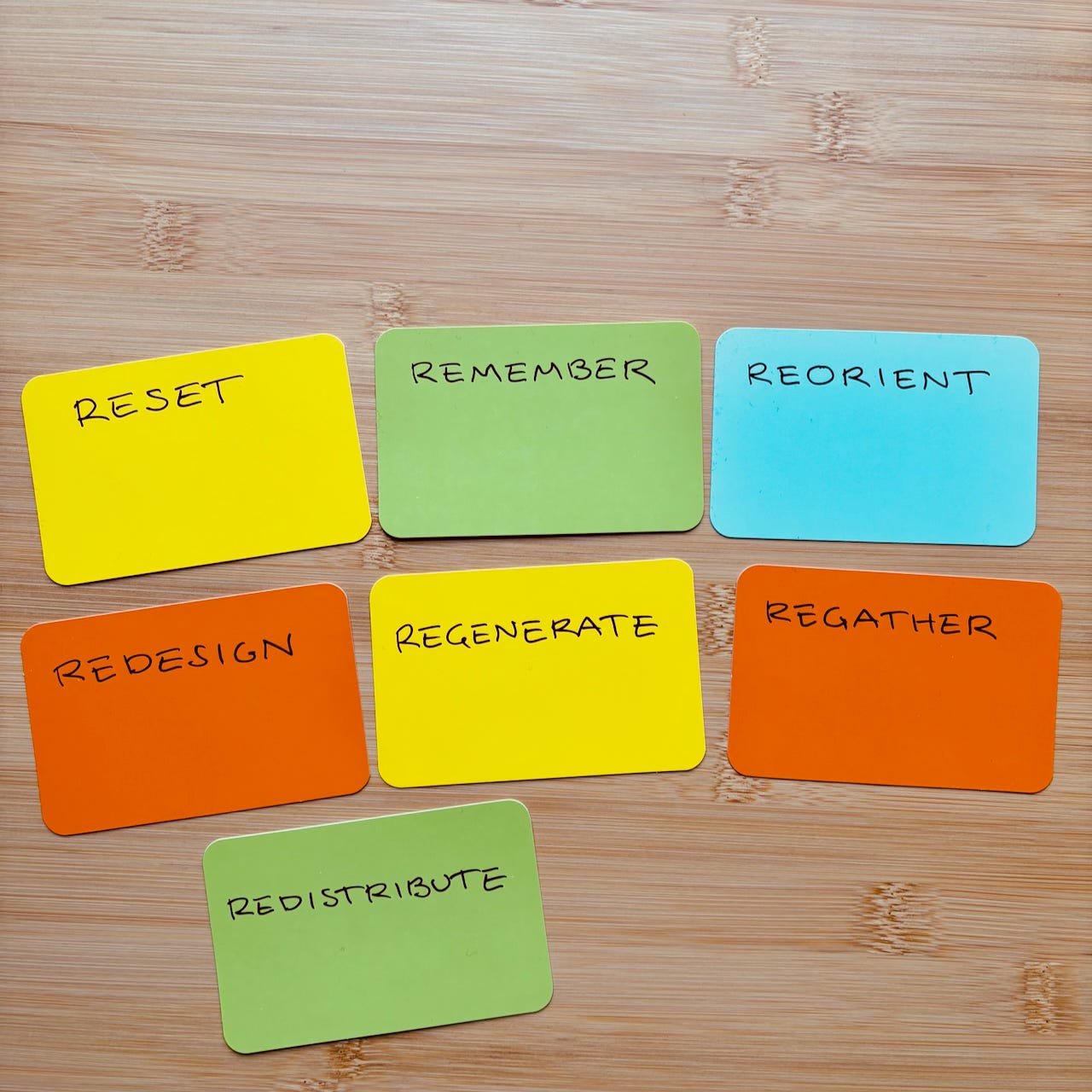
We still need ideation and testing, and all the rest of it (a DT-like process) to build things, but from regenerative ends. We need to unthink and unsee many premises, and re-see the world and ourselves, as part of it, as a connected organism and metabolism, and then start undesigning the past ways of overreaching. I suggest that we require a process where several things are re-thought andre-done: we need to Reset, Remember, Reorient, Redesign, Regenerate, Regather, and Redistribute.
More of what those steps meand and how we might do that in the second part — see link below! Thank you for reading.
With love and kindness,
Aki
Undesign thinking

To design ‘environmentally improved’ versions of existing products or buildings will not deliver a condition of sustainment. This is because current ‘practices and products of ‘sustainability’ just cannot displace the sheer mass of the unsustainable. — Tony Fry,